
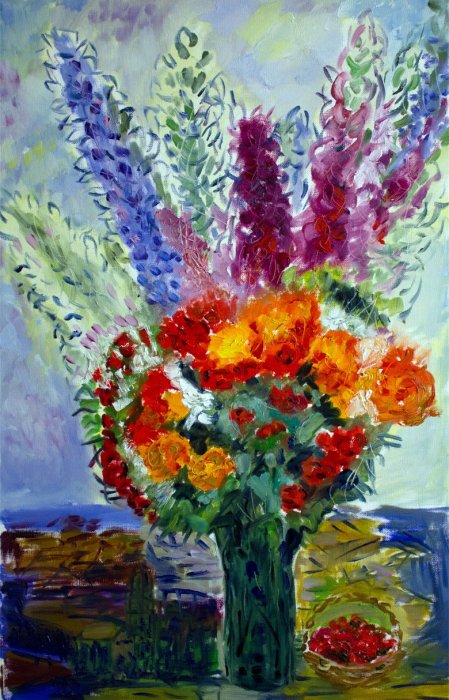
Oil painting is a technique of painting using oil paints. Oil paints are made from pigments mixed with oil, such as linseed, sunflower, or walnut oil. The oil binder allows the pigments to mix smoothly and create a smooth, even surface. Oil painting is one of the oldest and most popular painting techniques. Oil painting is used to create a wide range of artworks, including portraits, landscapes, religious paintings, and abstract works.
Advantages of Oil Painting:
- oil paints enable the creation of realistic images;
- oil paints are resistant to damage;
- oil paints can be used to achieve various effects.
Oil Painting Involves the Following Main Stages:
1) Priming. The first layer, also known as priming, is applied in transparent or translucent shades to define basic shapes, tones, light and shadow. The priming can be monochromatic (one-colored) or polychromatic (multi-colored);
2) Underpainting. The underpainting is a technique used in painting where a thin layer of paint is applied to the canvas (or another prepared surface) before the main colors are added. This layer adds depth, detail, volume, and texture to the final painting. The underpainting can be done with the same paints used in the subsequent layers, or with paints that have a higher viscosity and coverage for better foundation building;
3) Detailing. After the base layer has dried, you can begin adding details. Details are what make a painting realistic or abstract;
4) Final Painting. The final layer of paint, also known as the final painting, is applied over the underpainting to complete the image, correct mistakes, emphasize accents, add contrast, expressiveness, and harmony. The final painting can be done with the same paints as the underpainting, or with others that are thicker and have a higher gloss.
Oil artists need to learn how to mix paint. They also need to learn how to use brushes and palettes. Additionally, they need to learn how to create smooth transitions from one color to another and apply paint evenly.
We teach students how to mix paint using a variety of techniques, including blending, which is the process of mixing two or more colors together to create a smooth transition; scumbling, which is the process of applying paint with a light, dry brush to create a rough, textured effect; and glazing, which is the process of applying thin layers of paint over a dry surface to create depth and transparency.
Learning to Draw Is Easy!
The oil painting course contains 15 lessons of 3 hours, once a week, for a total of 45 hours. All materials are included in the price of the course.
Tuition fee: UAH 6,000 for the entire course (UAH 400 per class), attending a separate class without paying for the course – UAH 450. 10% discount for servicemen of the Armed Forces, their wives, children, as well as for large families.
Oil Painting Course Program
Lesson 1. We Learn to Create a Shape Using Two Colors. Transition from One Color to Another. Grisaille Technique
Lesson 2. Spectrum. Color Mixing. We Learn to Draw Fruits
Lesson 3. Aerial Perspective. Landscape
Lesson 4, 5. Still Life in a Warm Tone
Lesson 6. Sgraffito: The Technique of Applying Notches and Scratches
Lesson 7, 8. Still Life in a Cold Scale
Lesson 9. Landscape with Reflection in Water
Lesson 10, 11. Still Life from Glass Objects
Lesson 12. Urban Landscape
Lesson 13, 14. Tea Still Life
Lesson 15. Seascape
Feel free to find out the details and sign up for the course! Contact now.
Also, our artists can create a custom oil portrait for you, based on a photo you provide.
Some Works of Students From the Course of Oil Painting:


