
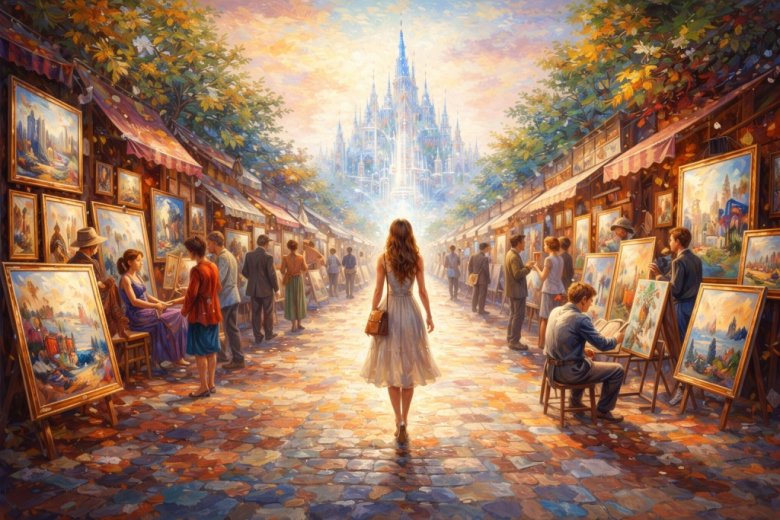
 Have you ever scrolled through Instagram, looking at other artists’ work, and felt something tighten inside you? Your fingers hover over the screen, your eyes glide across flawless canvases, and suddenly your own sketch seems hopelessly amateur. It is a feeling familiar to anyone who has ever picked up a brush or a pencil.
Comparing yourself to other artists is one of the most common traps on the creative path, especially for those who have only just begun their artistic journey. But let us be honest: comparison is a natural human tendency. In art, this tendency is amplified threefold, for every work is a baring of the soul, revealed on canvas. Yet it is precisely at this moment that it is important to grasp a fundamental truth: the very artist whose work impresses you once held a brush with an uncertain hand.
Different Points on the Same Path
Imagine that art is a vast mountain, which every artist conquers by their own route. Some have already reached the summit, some are halfway up the slope, and some have only just taken their first steps from the foot. When you compare yourself to someone who has already covered half the distance, you are not comparing equal positions. You are looking at the result of years of practice, thousands of hours of experimentation, and hundreds of failed works that never reached a wider audience.
Many beginners who sign up for painting courses, come with the superstition that talent is something innate – that you either have it or you do not. In reality, art is a skill that is forged over years of diligent work. Yes, some may have a natural aptitude for colour or composition, but without practice even the most gifted person will rarely create anything of significance.
When you look at the work of masters – whether in a museum, at an exhibition, or online – remember that you are seeing only the final result. You do not see the hundreds of sketches that preceded this canvas. You do not see the disappointments, the reworkings, the moments when the artist wanted to give it all up. You do not see the years of study, when their work was just as imperfect as yours is now.
How to Learn to Draw by Looking at Others the Right Way
The paradox is that the work of other artists can be both a source of inspiration and a cause of creative block. The secret lies in how you look at them. Instead of thinking “I will never be able to do that”, try asking yourself: “What exactly do I like about this work, and how can I learn this technique?”. This shifts the focus away from self-criticism and towards learning.
Professional artists often say that their progress accelerated once they began to analyse, rather than envy. Did you notice a stunning interplay of light and shadow? Instead of sighing “I could never do that”, take the time to study how the artist achieved it. What direction of brushstrokes did they use? What palette did they choose? How did they build the composition? Many answers can be found simply by looking at the work carefully. Other beginners find answers on drawing courses, where experienced teachers reveal and help you master professional secrets.
Another useful approach is to create yourself a “creative treasure trove”. When you see a work that inspires you, save it not for self-flagellation, but for study. Collect references, analyse techniques, and identify the elements you want to master. This transforms other artists from competitors into teachers, and their work from a source of frustration into study material.
Your Unique Voice
One of the biggest mistakes beginners make is trying to copy the style of artists they admire. Of course, learning from the work of masters is a wonderful practice. Copying the works of great artists has been part of art education for centuries. But there is a fine line between learning through copying and losing your own identity.
Every artist is unique not only in technique, but also in their vision of the world. Your life experience, emotions, memories, dreams – all of this shapes a unique lens through which you perceive reality. When you become too fixated on drawing “like him” or “like her”, you suppress your own voice, which is only just beginning to take shape.
Your “imperfection” right now is in fact your authenticity. Those “mistakes” that you see in your work can become the foundation of a unique style. The history of art is full of examples in which what initially seemed like a flaw became the artist’s signature. Trembling lines can convey raw emotion. Unusual colour combinations can create an extraordinary atmosphere. Simplified forms sometimes turn out to be more expressive than photorealistic precision.
Practice Without Comparisons
So, how does one learn to draw without sinking into the swamp of comparisons?
- The first rule is to set yourself personal goals that do not depend on others. Instead of “I want to draw like [name of an artist]”, set yourself a goal of “I want to learn the wet-on-wet technique” or “I want to learn to convey volume through chiaroscuro”. Such specific, measurable goals give a sense of progress without the need to compare yourself to anyone.
- Keep a journal of your creative journey. Photograph your work, even if it seems dreadful to you. After a month, three months, a year, you will look back and see your own progress. This is the fairest comparison – yourself against your former self. When you see how your brushwork has improved, how your proportions have become more precise, how your palette has grown richer, a genuine motivation to keep going begins to emerge.
- Regular practice is what matters above all else. Not the intensity of your talent, not a genetic predisposition to art, but daily, consistent work. Even if you can dedicate only fifteen minutes a day to drawing, but do so systematically, after a year your progress will be striking. Academic painting courses can give you structure, practice, and professional guidance, but nothing can replace your own hours at the easel.
- Experiment without fear. Try different techniques, materials, styles. Perhaps oils suit you better than watercolour. Perhaps your strength lies in line work rather than colour. Allow yourself to search, to make mistakes, to try something new. It is precisely in this process of searching that a true artist is born.
When Comparison Can Be Useful
Comparisons with other artists can also be useful. There is a difference between toxic comparison, which paralyses, and constructive analysis, which inspires. The former focuses on the gap between you and others, feeding a sense of inadequacy. The latter uses the work of others as a roadmap for your own development.
How to tell the difference?
- If, after looking at the work of other artists, you feel the urge to pick up a brush and paint – that is healthy inspiration.
- If, on the other hand, you feel the desire to close your sketchbook and never return to art again – that is toxic comparison.
- The former adds energy; the latter drains it.
Use the work of masters as guidelines, not as verdicts. When you see a stunning portrait and think “I want to learn to capture facial expression like that”, that motivates you to develop. You could even commission a portrait, by approaching a professional artist to study how they work with form, light, and detail. This is not copying, but learning through observation – a practice that almost all the great masters of the past employed.
The Value of Your Own Path
The most important thing to understand at the start of your artistic journey is this: art is not a sprint, nor a competition. It is a marathon the length of a lifetime, in which the only rival is your former self. Every artist develops at their own pace, and that is perfectly normal. Some need more time to master colour, others to understand composition.
Your creative path is unique not only in its results, but also in its process. The joy of creation is what matters most. If you draw solely in pursuit of some ideal, the very meaning of art is lost. Creativity is a way of engaging with the world, a form of self-expression, a meditative practice that heals the soul.
Allow yourself to enjoy the process of learning. Yes, sometimes it is difficult, sometimes the result does not live up to your expectations. But there is a particular magic in watching a blank canvas come to life under your hand, in seeing forms emerge from a chaos of lines, in colours weaving themselves into harmony. This wonder is available to you right now, regardless of your level of skill.
Remember also that art is subjective. A work that seems to you a failure may move another person deeply. What one critic calls a flaw, another will see as a unique expressiveness. Your perspective, your sensitivity, your vision of the world have value in their own right.
Practical Steps Towards Creative Freedom
If you feel that comparing yourself to others is hindering your development, try a few practical strategies.
- First, limit your time on social media. A Facebook or Instagram feed full of polished work can become a source of constant stress. Set aside a specific time for browsing other people’s work, and an equal amount for your own practice.
- Second, reframe your inner dialogue. Instead of “I draw badly”, say “I am learning to draw”. Instead of “I have no talent” – “I am developing my skills”. These small changes in language affect how you perceive yourself and your journey.
- Third, find a mentor or teacher who understands the psychology of the creative process. Professional one-to-one drawing lessons often include not only technical aspects, but also work on creative blocks, fears, and doubts. An experienced mentor will help you see your potential where you see only shortcomings.
Trust in the Process
The hardest thing for a beginner artist is to trust their own creative process. Some people crave quick results, instant recognition, immediate progress. But art does not work that way. It demands patience, perseverance, and faith in yourself even when there is no visible result yet.
Imagine a gardener who has planted a seed and goes to check every day whether a flower has sprouted yet. The gardener cannot see that the seed is germinating underground, that the roots are gradually strengthening, that invisible work is happening every minute. It is the same with your artistic development. Even when it feels as though there is no progress, every hour of practice is changing your inner world, training your hand, and shaping your artistic vision.
Trusting the process also means accepting unexpected or unwanted results as an inseparable part of learning. Every “failed” work is a valuable lesson about what does not work. Thomas Edison said that he had not failed, but had simply found ten thousand ways that do not work. In much the same way, each of your “failed” drawings is in fact bringing you closer to an understanding of what works for you. Without mistakes, there is no learning.
In the end, it is worth accepting one fundamental truth: perfection in art does not exist. Even the most celebrated masters have said that they consider themselves eternal students. Every work is a step on a journey, not a final destination. In comparing themselves to others, people so often steal from themselves the joy of this journey. But if you compete only with your former self, every day brings small victories.
So, draw. Draw, even when it feels as though it is coming out badly. Draw, even when someone else does it better. Draw, because it brings you joy, because it is your way of talking to the world, for your perspective is unique and worthy of expression. Leave the obsessive comparisons to those who have forgotten why they picked up a brush in the first place.


