
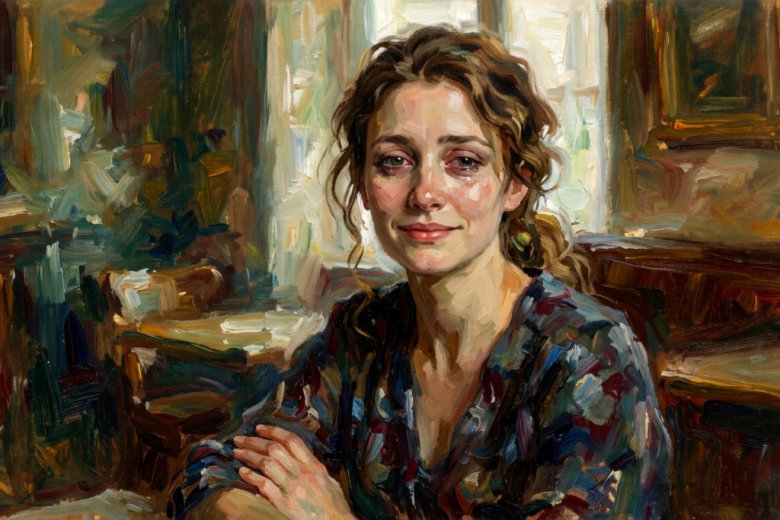
 A portrait is not simply a likeness of a face. It is a conversation between the artist and the viewer, conducted not through words but through shades of colour, forms and textures. When you first pick up a brush and attempt to capture a living face on canvas, the hardest part is not proportions or anatomy. The hardest part is breathing genuine feeling into the painted person. It is precisely this ability that separates a work that hangs on a wall as decoration from one that stops a passer-by in their tracks and holds them before the canvas for minutes on end.
For a beginning artist, discovering this language is one of the most moving moments in a creative life. You suddenly realise that you are not painting eyes, but a gaze. Not a mouth, but a smile about to fade. Not skin, but the warmth or cold that radiates from it in waves.
Why Emotions Are the Heart of a Portrait
People read faces instinctively – it is wired into us by evolution. In a fraction of a second we gauge the mood of a stranger in a crowd, detect the falseness of a “polished” smile and see genuine joy even through tears. That is precisely why a viewer looking at your portrait will also instantly “scan” the face on the canvas. They are looking for something alive.
If your work is technically largely correct but emotionally empty, the person will walk past. But if through correct or even “incorrect” lines a character, a mood, an inner state shines through – they will want to stop. After commissioning a portrait from a professional portrait painter, the artist will – even before touching the canvas – begin the work in their imagination with the question: what feeling do I want to convey?
The answer to this question determines everything: from the choice of colour palette to the character of the brushstroke, from the position of the model”s head to the way the light falls on their cheek. Emotion is not the finishing touch; it is the foundation upon which the entire work is built.
Very often beginners think that what they lack is technique in order to make a “living” portrait. In reality, technique is merely a tool; the main thing is to learn to see and to decide what, precisely, you want to tell.
Eyes That Speak Louder Than Words
If there is one single detail that “switches on” or “switches off” the emotion in a portrait, it is the eyes. It is no accident that they are called the mirror of the soul: they are where the viewer looks first and where they seek the truth.
The gaze in a portrait depends not only on the shape of the pupil or the highlight on the cornea. It depends on the direction in which the model is looking, on how tense or relaxed the muscles around the eyes are, on how raised or lowered the eyelids are. A person in the grip of grief looks slightly downward and inward – even if their eyes are open. A person in a moment of joy seems to look wider than their eye sockets would allow.
There is one practical piece of advice for the beginning artist: paint the eyes last, or at least refine them at the end of the work. First establish the general mood through colour, light and pose – and only then “bring the gaze to life”. In this way you do not “over-invest” emotion in a single detail but distribute it across the whole canvas. Also, remember: eyes are never perfectly symmetrical. A slight asymmetry is what makes a gaze feel alive.
Learn to read your own eyes, too. Sit in front of a mirror and try to depict different states – surprise, calm, anxiety, tenderness. Pay attention to how the shape of the upper and lower eyelids changes, where fine wrinkles appear, how the eyebrows move. This study will give you more than dozens of academic textbooks.
Colour as the Language of the Soul
One of the most powerful tools for conveying emotion in a portrait is colour. It acts on the viewer”s unconscious before they have had time to process what they are seeing. Warm skin tones with a yellowish-ochre base speak of cosiness, health and presence. Cold, greyish-lilac tones convey a sense of fatigue, melancholy or detachment.
But it is not merely a question of whether colour is warm or cold. Saturation and contrast matter too. Very bright, saturated colours in a portrait convey energy, passion, and sometimes anxiety. A muted, almost monochrome palette creates an atmosphere of contemplation, nostalgia or inner calm. That is precisely why, when choosing oil as the medium for a portrait, artists gain a unique opportunity: oil paints allow for endless layering, blending of tones directly on the canvas, and the achievement of a depth of hue impossible to replicate in watercolour or gouache.
A practical tip for beginners: before starting a portrait, make a small colour sketch. Decide which overall temperature will dominate and what emotion it is to support. This will not limit your freedom – on the contrary, it will give you a point of departure. The most common mistakes are: a palette that is too varied, which “fragments” the unified mood, or an excessive attempt to reproduce the skin colour “accurately”, resulting in a lifeless, “catalogue” tone.
Try adding to the flesh tone an unexpected hue – a touch of bluish-green in the shadows, a touch of pinkish-violet in the brightest areas. Human skin is never a single colour. It is precisely these nuances that make a portrait pulse, and in this way you breathe life into it.
Brushstroke, Texture and Character
The way you apply paint to canvas tells the viewer as much about your model as the proportions of their face do. A broad, bold brushstroke conveys decisiveness, energy, and at times restlessness. A soft, almost imperceptible transition of tones speaks of tenderness, fragility and concentration.
Artists working on an oil portrait often use contrast between carefully worked passages – the eyes, the lips – and freer, more sketch-like areas, such as the hair or clothing. This difference in the density of treatment itself directs the viewer”s gaze and creates a hierarchy of importance. Where the stroke is precise and detailed, tension arises. Where it is light and free – there is breath.
Do not be afraid to leave the mark of the brush visible. Sometimes it is precisely this “incompleteness” – intentional or not – that most truthfully conveys a moment, a mood, a movement. The Impressionists understood this better than anyone: the brushstroke is not a means of filling a form; it is an event that carries meaning in itself.
It is worth speaking separately about the palette knife. This simple tool – a spatula used to mix paints – allows paint to be applied in thick, textured layers. In portrait work the palette knife produces a striking effect: raised areas catch the light and literally “come forward” towards the viewer, whilst recesses sink into shadow. This works particularly well for conveying inner strength, characterfulness and the “weight” of a subject.
Composition and Space: Where Mood Resides
Where the person looks in a portrait is not merely a technical question. A gaze into the empty space before them suggests anticipation or daydream. A gaze to the side and downward suggests reflection or sadness. A gaze directed straight at the viewer suggests challenge, openness or trust, depending on how everything else around it is arranged.
The space around the figure also “speaks”. If the person fills almost the entire canvas, framed in close-up with no “breathing room”, a sense of claustrophobia, pressure and immediacy arises. If there is a great deal of open space around the head, this can convey solitude, detachment, or conversely, the breadth of an inner world. When artists who offer portrait commissions discuss the details of a forthcoming work with a client, the question of format and the “air” around the figure is one of the first. For it directly affects the feeling the finished work will leave behind.
The tilt of the head is another “quiet” signal. A gentle tilt to one side adds softness and openness. A head held straight and slightly raised conveys confidence, even a degree of pride. Lowered – concentration or humility. Experiment with these nuances at the sketch stage, to avoid reworking a finished piece.
Practice That Changes Everything
Conveying emotion in a portrait is a skill that can and should be trained deliberately. There are several practices that genuinely accelerate the development of this ability.
- The first is to make “emotional sketches”. Pick up a magazine, a newspaper or open a news website and draw 5–10 tiny face sketches with different expressions. Do not try to achieve likeness – only to capture the mood. This exercise teaches you to see emotion as a form rather than as an abstraction.
- The second practice is copying the masters. Choose works in which emotion is expressed with particular force – Rembrandt, Van Dyck, Sargent, Schiele, Hals. Copy them not mechanically, but trying to understand: what precise technique did the artist use to achieve this effect? What did they do with the colour in the shadows? How did they treat the edges of forms? Where did they leave “incompleteness”? Such an analytical copy will teach you more than any amount of theoretical reading.
- The third practice is drawing from life as much as possible. A photograph fixes a single moment, a single position of the muscles. A living person breathes, moves, changes – and the artist is forced to “catch” what matters, rather than what merely happens to be in front of their eyes. Even if you plan later to create portraits from photographs – the city where you live is full of living faces in cafés, parks and on public transport. Draw there, draw quickly, draw not always correctly – in this way you build an inner “bank” of images from which you will draw in the studio.
- The fourth practice is a “reverse review”. After finishing a work, step away from it, then come back a day later and ask yourself one question: what emotion do I feel when I look at this portrait? If your answer matches what you intended to convey – you are on the right path. If not – this is valuable information about where your intention was “lost”.
When a Portrait Becomes a Dialogue
The greatest lesson that can be drawn from working on a portrait is the understanding that the artist and the model are always engaged in dialogue. Even if the person is not present, even if you are working from an old photograph – you are trying to hear something in that image and to pass it on.
That is why a portrait from a photograph demands of the artist particular attentiveness. A photograph may be technically excellent yet “dead”. The master”s task is to find behind the pixels a living person, to understand what is unique about them, and to bring this onto the canvas. Not simply to “reproduce”, but to “hear” and to say something of one”s own.
When people turn to an experienced artist to commission a portrait, they often cannot express in words what they want. They say: “I want you to be able to see what a kind person she is.” Or: “So that his stubborn character comes through.” Or simply: “So that the painting radiates warmth.” This is the language of emotions – and it is precisely this language you are learning to speak when you become a portrait artist.
Your brush is not a tool for copying reality; it is a means of translation – from the language of feelings into the language of lines, colours and forms. And the more you practise, the more you allow yourself to feel during the work, the more precise and profound this translation becomes. May each new portrait be not merely a technical task but a true encounter – with the person you are painting, with yourself, and with that boundless space where human feelings reside.


