
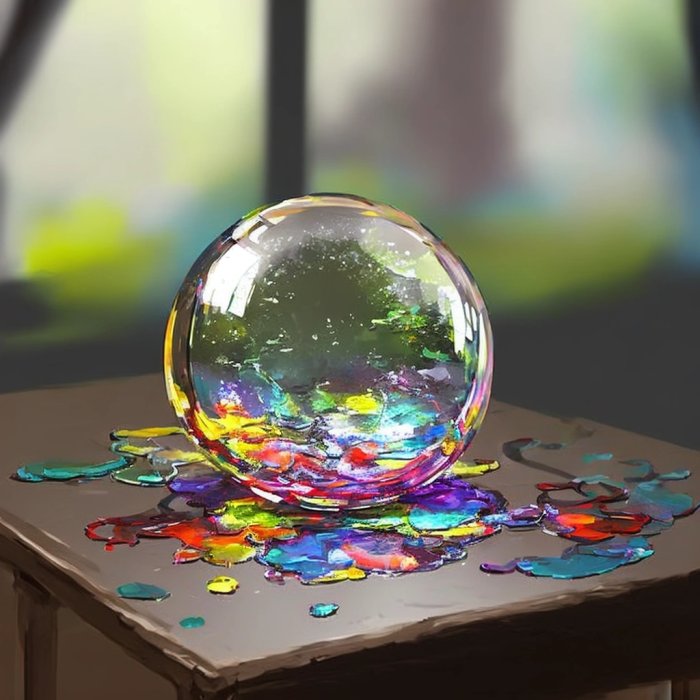
 Transparent objects have always intrigued artists, evoking both admiration and a certain trepidation. A glass of water, a crystal vase, or even an ordinary plastic bag – these all seem challenging to depict, as such objects have little to no color of their own. How can one capture lightness, the play of light, and the distortion of form? How can transparency be created without actual transparency?
To understand this, it is important to begin by understanding the nature of transparent objects. They transmit light, refract it, and reflect surrounding colors. Therefore, the artist does not simply paint the outline of the object, but recreates how the object interacts with space and light.
How to See Transparency?
The first thing to do when tasked with depicting a transparent object is to observe it closely. This may seem obvious, but many beginner artists treat transparent objects as if they are nonexistent. They attempt to capture only the outlines, forgetting about reflections, distortions, and subtle transitions in light.
Transparent objects do not have defined color boundaries. Instead, they change their hues according to their surroundings. Water in a glass may appear grayish when placed against a dark background or yellowish-blue when reflecting daylight. A glass cup may have dark edges even if it is nearly colorless.
- Before you start painting, conduct a small experiment. Take any transparent object and place it in front of different backgrounds. Change the lighting, observe the reflections and shadows. This will help you understand how transparency behaves in various conditions.
The Play of Light and Shadow
Light plays a key role in conveying transparency. Without proper lighting, even the most perfect drawing will not appear realistic.
Imagine a glass of water on a table. It casts a shadow, but this shadow is not as dense as one from an opaque object. Water refracts light, so within the shadow, there may be bright spots, and the edges will appear soft.
If the light comes from one side, reflections may appear on the surface of the glass. The brightest reflections form where the light is directly reflected, while softer transitions occur in the areas of diffused lighting.
Transparency also depends on the thickness of the material. Thin glass allows more light to pass through, while thick glass may appear darker. This is especially noticeable with crystal vases or bottles: their edges often have a rich hue, even under bright lighting.
The Color of Transparent Objects
One of the most common mistakes in painting transparent objects is making them completely colorless. In reality, even the clearest glass or pure water interacts with the surrounding colors. If you place a glass on a red napkin, its bottom usually takes on a faint reddish hue. If a green object is nearby, green reflections may appear on the sides of the glass.
It is particularly fascinating to observe how the color of water changes. Water in a glass can look slightly blue when lit by natural light or yellowish under artificial lighting. These small nuances make a drawing feel alive and realistic.
How to Achieve Realistic Transparency? Tips for Artists
1. Observe, Don’t Guess
Often, beginner artists paint a transparent object the way they imagine it, not the way they see it. For example, they might make a glass uniformly gray or completely colorless.
- Tip: Carefully examine the object before you start painting. If possible, take a photo and compare it with your observations. Are the edges of the glass really the same brightness? How does the light behave on its surface?
2. Use Shape Distortions
One of the trickiest parts of drawing transparent objects is distorting what lies behind them. Water in a glass can change the shape of a spoon, and glass can shift the outlines of the background.
- Tip: Choose a transparent object, place something behind it (like a pencil), and look closely. Do the lines stay straight? Draw the object twice: once without the glass, and once through it.
3. Remember the Reflections
Transparent objects act like mirrors: they not only refract light but also reflect the colors of their surroundings.
- Tip: If you’re painting a glass on a red napkin, don’t forget to add reddish reflections on the bottom of the glass.
4. Leave Room for Light
The sparkle on the surface of glass or water is key to creating the effect of transparency.
- Tip: If working with watercolor, leave areas for bright spots to remain white. If using oil or acrylic, add highlights at the end of your work using white paint or semi-transparent layers.
5. Don’t Outline
A dark outline around a transparent object will make it opaque and “cut it out” from the space.
- Tip: Instead of drawing a sharp outline, use color transitions.
6. Practice with Simple Shapes
If drawing a glass seems too complicated, start with something simpler: a water bottle, an ice cube, or a piece of glass.
- Tip: Try drawing a transparent object in several variations: with no background, on a dark background, and on a colored surface. This will help you understand how transparent materials interact with their surroundings. It’s also useful to start with sketches – using simple pencil or charcoal – to refine your sense of light and shadow before moving on to color.
In conclusion, conveying transparency in painting is a game of light, reflections, and refraction. The artist does not paint glass or water – they paint their impact on the environment. Observe, analyze, experiment – and even the simplest glass of water will appear realistic and alive.


