
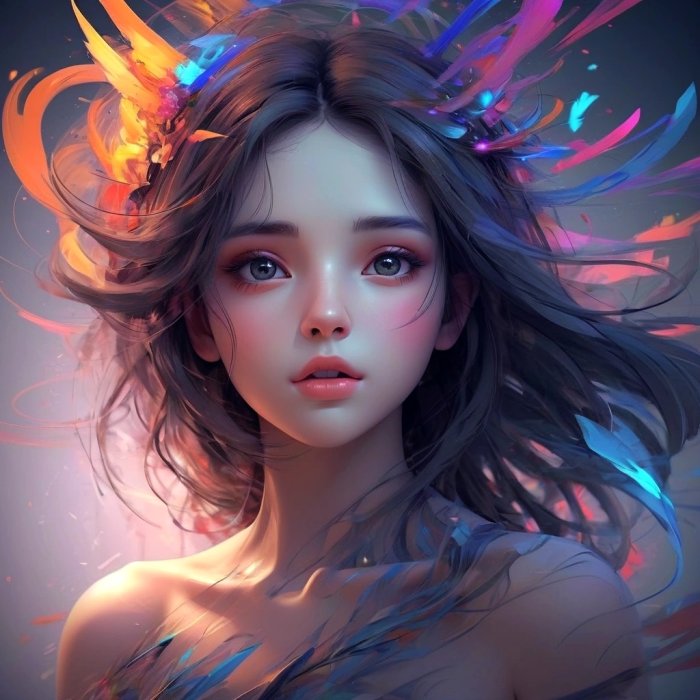
 Just ten years ago, hardly any of my artist friends gave digital art much thought. Studios still smelled of oil paint, familiar brushes were always at hand, and palettes were real – splattered with color and marked by fingerprints. Today, I hear more and more often: “I tried drawing on a tablet – it’s a completely different feeling”. Some even admit, “Now I can’t imagine my creative process without a graphic editor”.
The Advantages of Digital Art
So what is it about digital art that’s so appealing? First and foremost, it’s the sense of freedom. When you work in Photoshop or Procreate, you’re not afraid of ruining your piece: you can always step back, change a color or shape, try a new style. For me, it feels like an endless space for experimentation. Didn’t like a stroke? Erase it and try again. No need to spend money on paints, canvases, or solvents. And there’s no need to find storage for dozens of finished works – everything fits on a flash drive or in the cloud.
Digital painting as a separate direction allows you to imitate almost any classic technique – watercolor, oil, pastel, charcoal, or ink. Many programs let you customize your own styles, combine textures, experiment with transparency, and create unique effects that are difficult to achieve in the physical world. This expands the artist’s palette, lets you break away from familiar solutions, and even create hybrid works that combine photography, drawing, and 3D graphics.
Another major advantage is mobility and accessibility. An artist can create anywhere with just a tablet or laptop. Digital works are easy to store, copy, share online, participate in international competitions, and sell worldwide – no shipping or framing costs. On top of that, digital formats make collaboration easier: several artists can work on the same project simultaneously, even from different countries.
There’s also the economic aspect: digital art doesn’t require spending money on paints, canvases, or other materials, and it doesn’t produce waste or take up space in the studio. For many, it’s also an environmentally responsible choice.
The Challenges of Digital Art
But with all this come new challenges. Can you really feel true texture when working with a stylus on glass? Can a screen convey the same depth of color as real pigment? I’ll admit, in digital art I miss the smell of paint and the roughness of canvas under my fingers. Some colleagues say that tactile contact with materials is a source of inspiration for them. In digital work, the feeling is different – more detached, though no less fascinating.
Another point is speed. In the digital environment, the process often moves much faster. You can do in an hour what would take days with paints and brushes. This opens up new possibilities for experimentation but also makes you wonder: does this speed come at the cost of depth of experience or the slow meditation over each layer of paint?
Digital art erases boundaries. Today, an artist from Kharkiv can show their work to a viewer in New York or Tokyo within minutes. Online galleries, NFTs, instant sales – all this once seemed like science fiction, but it’s now an everyday reality for many young artists. Yet for those used to exhibiting in physical galleries and interacting with viewers in person, this is a new challenge. It means learning not just new software, but new ways to communicate with the world.
At the same time, the digital world doesn’t negate the value of tradition. Many combine both approaches: starting with a pencil sketch and finishing it in a graphic editor. Some print digital works on canvas and then add texture with oil or acrylic paint. This is how hybrid works are born, where the spirit of tradition and the energy of innovation coexist.
Questions of uniqueness and authorship deserve special attention. With the advent of artificial intelligence and generative algorithms that can create images in the style of famous artists or combine different styles in one piece, new ethical and legal dilemmas arise. Where is the line between inspiration and copying? How do you protect your ideas in the digital space? These are questions the art world is still grappling with.
There’s also a technical issue. The quality of monitors and printers still doesn’t allow for the same level of detail the eye sees on a real canvas. Printing a digital work doesn’t always convey color nuances, and a screen uses the RGB model, while traditional painting is seen in reflected light. This creates new challenges for those who want to combine digital and traditional media.
Should traditional artists avoid digital art? In my view, no. It’s not an enemy in your creative world, but another tool in your vast palette. The main thing is to trust yourself, not to fall for easy solutions, and to search for your own path – one that reveals the boundless potential of your inner world, combining the experience of the past with the possibilities of the future.
So – be ready to experiment. If you’ve never tried digital drawing, give yourself a chance. Start simple, let go of rigid boundaries. Maybe it’s in this combination of pixel and brush that you’ll find your new creative freedom. Keep notes about your impressions, analyze what inspires or challenges you, and keep moving forward: the digital world is incredibly multifaceted, and every experiment can open up unexpected horizons.


