
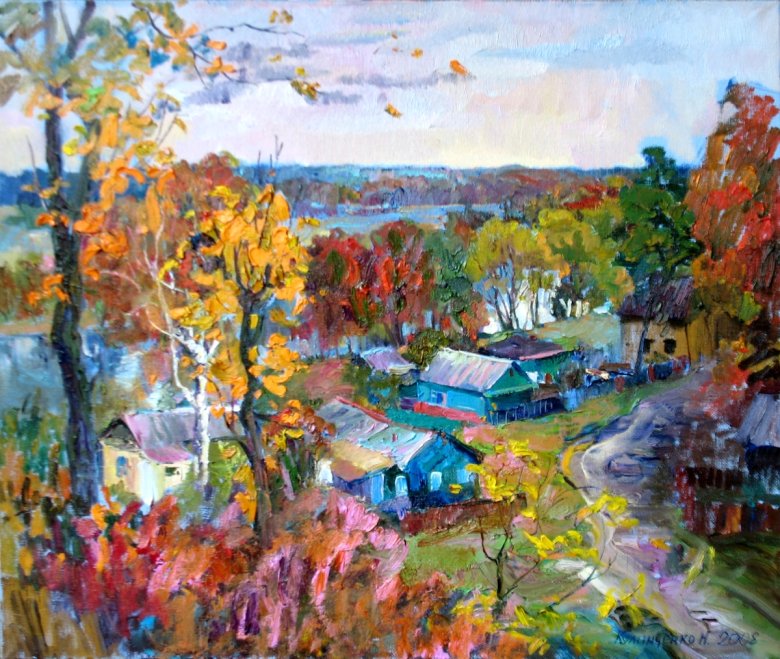
 Autumn arrives like a master colourist who isn't afraid to experiment with the boldest combinations. It transforms the world into a living painting, where ochre dances with crimson and golden leaves play against muted grey skies. For an artist, this is not just a season – it's both a challenge and an invitation, an opportunity to capture a moment when nature itself becomes the greatest teacher of composition and colour.
Many begin their journey in painting courses with autumn landscapes, as this season forgives beginners' mistakes and generously rewards boldness. Even an imperfect brushstroke can look organic in the chaotic variety of autumn foliage, whilst accidental paint runs resemble genuine natural colour transitions.
Oil Paints: The Depth of Autumn Melancholy and Hidden Joy
Oil painting gives autumn what it needs most – time. The slow drying of oil allows you to work on colour transitions for hours, and sometimes days, creating those same soft gradients with which the sky bids farewell to the last warm days. When you apply yellow ochre to canvas and then mix in a drop of paints such as burnt sienna and cadmium red, you're not simply mixing pigments – you're recreating the very essence of withering, that melancholic process that transforms green into gold.
The special magic of oil reveals itself in the alla prima technique, when you work wet-on-wet. Imagine an autumn forest at dawn: the mist hasn't yet dispersed, tree contours are blurred, colours flow into one another. This is precisely the effect you can achieve when your brush glides across a fresh layer of paint, merging cool violet shadows with warm orange reflections.
Be open to muddy tones – autumn doesn't live in pure colours straight from the tube. The most interesting hues are born exactly where three, four, or even five different colours meet on the palette. Glazing with oil opens another dimension of autumn's palette, when thin semi-transparent layers create optical mixing and luminosity from within.
Try laying a thin layer of red over dry yellow – and you'll see how that special, internally luminous orange of autumn leaves is born, glowing from within. Significant attention is paid to this very technique in professional painting courses, where instructors help master the subtleties of multilayered painting.
Watercolour: The Transparency of Autumn Air
Watercolour and autumn speak the same language – the language of transience and changeability. This technique demands particular courage from the artist, as each brushstroke remains forever, without the possibility of correction. Yet it's precisely in this unpredictability that the beauty of watercolour autumn lies: when yellow paint spreads across wet paper and meets red, creating unexpected patterns that so resemble real leaves, where no two shades repeat.
The wet-on-wet technique is ideal for depicting autumn skies and misty mornings. Wet the paper, then allow grey, blue and light violet to spread independently, creating cloudy patches. Nature will do part of the work for you, and the result will be more natural than any planned transitions.
For detailing trees and fallen leaves, use the wet-on-dry technique, when the previous layer has completely dried. Here you can allow yourself colour saturation: Indian yellow for maple leaves still clinging to branches, condensed burnt sienna for oak, carmine for rowan. But always remember the whiteness of the paper – this is your brightest light, your highlights on wet branches after rain, the rays of sun through leaves. Don't cover everything with paint; allow the paper to breathe.
Acrylic: A Modern View of a Classic Season
Acrylic paints offer freedom that neither oil nor watercolour provides. They dry quickly, allowing you to work in layers without days of waiting, yet can simultaneously imitate the textures of both these techniques.
Try the impasto technique – apply paint thickly, with a palette knife or even fingers. Create the texture of fallen leaves layered on the ground, convey the volume of old tree bark. Acrylic allows you to build genuine reliefs on canvas. You can add a little modelling paste to the paint – and your autumn tree will have not just the illusion of volume, but also a real tactile surface.
If you dilute acrylic with water, it behaves almost like watercolour, giving transparent, airy layers. This works wonderfully for depicting autumn light – that special, slanting, golden radiance that breaks through sparse foliage. Apply semi-transparent layers of yellow and orange over an already painted landscape, and you'll see how your painting fills with light. In painting courses, acrylic often becomes students' favourite technique precisely because of its versatility and the ability to experiment without fear of ruining the work.
Impressionism: A Moment That Melts Away
Autumn is almost created for the impressionist approach. When you go out en plein air with an easel and see how the wind tears away leaves, how changing light plays on water, how quickly the sky's mood shifts – you understand that detailed realism is powerless here.
Work quickly, with short energetic strokes. Don't mix colours too carefully on the palette – allow them to mix optically, at a distance. Place a stroke of pure cadmium yellow and red side by side, and the viewer's eye will create orange itself, but much more vibrant than what you would have mixed independently.
Approach pure colour without fear. If you see a violet shadow under a tree – paint it violet, even if logic says the shadow should be brown or grey. Impressionism is about how light changes everything around, and the autumn sun truly transforms shadows into colourful symphonies.
Plein air outings organised by painting courses provide an excellent opportunity to practise impressionist technique in natural conditions. Working in the open air teaches you to capture changing autumn light and not linger on details, focusing on the overall impression.
Expressionism: Emotion More Important Than Form
Autumn isn't always quiet and melancholic. Sometimes it's tempestuous, dramatic, full of inner tension before winter. The expressionist approach allows you to convey not so much how autumn looks, but rather how it feels.
Use contrasts not only in colour, but also emotionally. Let the calm blue of the sky collide with aggressive orange foliage, let smooth horizon lines be torn by sharp tree strokes in the foreground. Expressionism allows you to be honest with your own feelings: if autumn evokes anxiety – paint anxiety, if euphoria from beauty – let your canvas scream with colour.
The thickness of the stroke also becomes a means of expression. Thick paint, applied with force, conveys passion, tension, energy. A thin nervous line can speak of fragility, transience, the tenderness of the last warm days.
Don't plan each stroke – allow your hand to move intuitively, and technique will become the direct expression of your emotion. Modern painting courses teach precisely this freedom of self-expression, where instructors encourage students to seek their own artistic language.
Abstraction: Autumn Beyond Form
Who said that autumn must necessarily be recognisable? An abstract depiction of autumn can convey its essence more deeply than the most realistic landscape. Take autumn's palette – all those mustard, terracotta, wine, golden shades – and allow them to interact on canvas without concrete forms.
Try the pouring technique, when paint flows down the canvas, creating unpredictable stains and streams – this can evoke rains washing colour from leaves. Or apply layers of coloured planes that overlap one another, like leaves overlapping leaves in an autumn carpet.
In abstraction, you're free to experiment with textures in ways impossible in figurative painting. Add sand to the paint – and you'll get the feeling of autumn earth. Use film or paper to create impressions – and unexpected textures will appear, reminiscent of bark, moss, fallen leaves.
Light and Shadow: The Soul of Autumn Painting
Regardless of chosen technique or style, working with light becomes the key to understanding autumn. Autumn light is special – it's lower, softer, warmer than summer light, yet simultaneously more dramatic due to the contrast with longer shadows.
Pay attention to the direction of light. Backlighting, when the sun shines in your eyes, makes leaves semi-transparent, luminous from within – this is the most enchanting way to depict an autumn tree. Side lighting creates dramatic shadows and emphasises the texture of bark, the unevenness of earth, the volume of everything you're depicting.
Shadows in autumn are never black or even neutrally grey. They're colourful, filled with reflections from autumn foliage, sky, surrounding objects. If the leaves above you are yellow, the shadow beneath the tree will have a yellowish tint. Learn to see these complex colour relationships – and your autumn paintings will come alive.
Composition: Where to Place Autumn on Canvas
The composition of an autumn landscape follows general artistic principles, but has its own tricks. Autumn provides you with a natural focus – a bright tree against dark ones, a red bush amongst a yellow field, a solitary leaf on water.
The rule of thirds works particularly well for autumn. Place the horizon not in the middle, but on one third from the edge of the canvas – and you'll immediately feel how the composition becomes more interesting. Place the main tree not in the centre, but to the side – asymmetry adds dynamics and naturalness.
Depth is important for landscape. Create three or four planes: a dark foreground with detailed leaves or grass, a middle ground with main objects, a distant plane with blurred outlines of trees or hills, and sky. Autumn helps divide these planes naturally – through difference in colour and saturation.
Particular attention is paid to work on composition in painting courses, where students learn to see and create balanced, yet not static images that hold the viewer's attention.
Colour Palette: Creating Your Own Autumn
Although typical autumn colours exist, the most interesting works are born when an artist forms their own palette. Start with a limited palette: take yellow ochre, raw sienna, burnt sienna, cadmium red or carmine, ultramarine and white.
Remember the green that still remains. Autumn isn't only a yellow-orange-red symphony. There are trees that keep their leaves green until the first snow, there are conifers, there are grasses. This greenery looks different against an autumn background – more saturated, deep, almost dramatic in contrast with warm shades.
Grey and brown are also autumn colours, and they're more important than they seem. They create the calm against which bright splashes of colour play even more expressively. Mix your own complex grey tones, combining complementary colours: orange with blue gives those rich, saturated greenish-grey tones so characteristic of autumn skies and wet tarmac after rain.
Practical Advice: From Idea to Realisation
The best way to learn to paint autumn is to go out and see it. Plein air teaches you to see colour relationships as no photograph can teach. Light changes every fifteen minutes, and you learn to work quickly, to capture the essence.
Make sketches, many sketches. Create quick studies where you explore one specific thing: the shape of a tree, the colour of shadow, the character of a brushstroke for depicting leaves. These studies are your own teaching material, a foundation to which you return when working on large canvases.
Experiment without fear of ruining the work. The most interesting discoveries happen at the edge of control and chaos, when you allow yourself to try something new. Perhaps you'll discover that your own technique is a combination of impressionist brushwork with abstract composition.
If you feel you need structured learning and professional support, painting courses offer various programmes – from basic techniques for beginners to masterclasses on specific styles for experienced artists. Learning in a group provides additional impetus: you see how others solve similar tasks, you exchange experience and receive feedback not only from the instructor, but also from your fellow students.
Final Brushstroke: Finding Your Own Voice
Autumn returns every year, and every year it's different. Similarly, your way of seeing and painting autumn will change with experience. What captivated you last year may seem uninteresting the next.
Most importantly – remain honest to your own perception. If autumn for you is joy rather than sadness, paint a joyful autumn, even if everyone around sees melancholy in it. If you feel in fallen leaves not an ending, but the promise of future renewal, your paintings will carry this message.
Technique, style, colour – all these are instruments for expressing your unique vision of the world. Painting courses can give you foundation, technical skills and confidence, but your artistic voice is something that's born only through practice, experiments and a sincere desire to express what you feel.
Autumn is generous to artists. It gives us the richest palette, the most dramatic light, the most emotional landscapes. All that's required of us is to take up the brush and respond to its invitation. Each autumn leaf that falls is a message about the transience of beauty, a reminder that we have only this moment to capture it.
So go out, look, feel and paint. Your autumn awaits its embodiment on canvas.


