
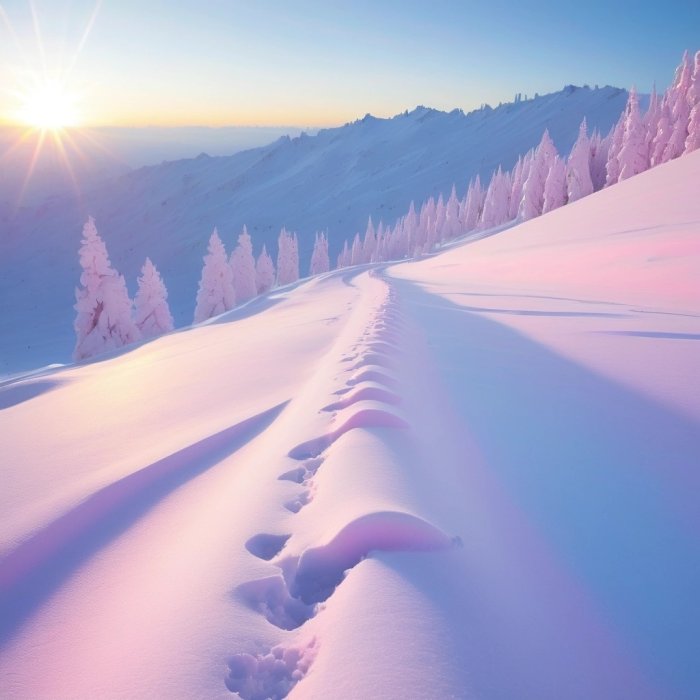
 When people untrained in painting look at the world around them, they often believe that snow is white, the sky is blue, and grass is green. But in reality, things are far more complex. Pure colors are almost never found in nature. What we perceive depends on lighting, reflections, transparency, texture, and the context of objects. Understanding this nuance allows artists to create more realistic and emotionally resonant works.
Pure Colors – Only in Theory
In color theory, pure white, red, blue, or any other hue can be imagined as absolute perfection. However, such colors are almost nonexistent in nature.
For instance, white snow actually contains countless shades: blue, yellow, pink, and green. This happens because of how light reflects off its surface and the surrounding environment’s colors that appear as reflections on the snow.
Reality imposes its own adjustments. Depending on the time of day, weather conditions, or even the season, we perceive snow differently. In the morning, as the sun rises, snow looks cool and bluish due to the reflection of sky light. At midday, its surface becomes brighter, taking on warm golden tones. In the evening, when the sky turns red and orange, snow can appear soft pink or even purple.
And it’s not just snow – this principle applies to nearly every object around us.
Snow Isn’t White, and Shadows Aren’t Black
The same concept applies to shadows. When you observe an object in shadow, the shadow is never purely black. It is filled with reflected light and colors from the surrounding environment. For example, a tree growing near green grass may cast shadows with a faint greenish tint. Meanwhile, those same shadows under a blue sky might take on cool blue or violet tones. Understanding how this interplay of colors works is crucial for an artist aiming to convey realism and atmosphere in their work.
Artists must learn to analyze how reflected light impacts colors in different conditions. This skill is especially vital in portrait painting, where reflections from skin or clothing on light surfaces can add a naturalistic touch. Similarly, in landscape painting, the proper use of reflections and hues helps create harmony between elements in a composition.
How to Apply This Knowledge in Painting
The first step to mastering this skill is careful observation of nature. An artist must not only look but also see, analyze, and understand how light and shadow shape the hues on surfaces. This takes time and practice. By venturing into nature or studying photographs, one can notice that the colors we assume to be obvious are, in fact, far richer in spectrum.
When you begin painting, it’s essential to remember that white is never just white. To convey realism, you must incorporate hints of other colors into white – perhaps a touch of blue, pink, or yellow, depending on the lighting and nearby objects. The same applies to other colors: each is influenced by its environment. Using smooth transitions between shades will help achieve depth and authenticity.
Beyond technical aspects, experimenting with colors enables the development of a unique artistic style. By adding unexpected but natural hues to your work, you make it stand out. For instance, instead of using standard black for shadows, try deep violet or rich blue. This approach yields a more vibrant and engaging result.
Another important technique is accounting for aerial perspective. Distant objects always appear less saturated and have cooler tones due to the influence of the air layer between them and the viewer. In landscape painting, this helps create a sense of depth and space.
The Benefits of Understanding Natural Shades
Mastering the art of conveying colors gives an artist significant advantages. Paintings become not only realistic but also expressive. Viewers feel an emotional connection to the work because it resonates with their own perception of the world. Moreover, understanding colors helps artists find their own creative voice since every artist sees the world uniquely.
Conclusion
Pure colors almost don’t exist in nature, and this is great news for artists. Observing shades, reflections, and the interplay of colors opens up limitless possibilities for creativity. Learn to see the world as it is – multifaceted and rich in hues. Use this knowledge to bring new vibrancy and depth to your works because true art begins where simple replication transforms into personal interpretation and the revelation of the world’s beauty.


